Touring Djakarta, batik, impressions of Indonesia, and big hats
Feb 23, 2026
In the last installment, K and Estella stopped in Bandung and did some sightseeing. Now they’re off to Djakarta for the last leg of the journey. Here are her travel journal entries from this part of the trip, with a few additions from a letter she wrote to family after the trip.
Tue. Dec. 30
Djakarta, Hotel Indonesia
Went for a city tour. Our guide, a young girl who had recently finished the University, was most excellent. She had attended Catholic schools, but is Muslim. We learned later that she spoke Chinese, Russian, French—as well as English and Indonesian. She was most attractive.
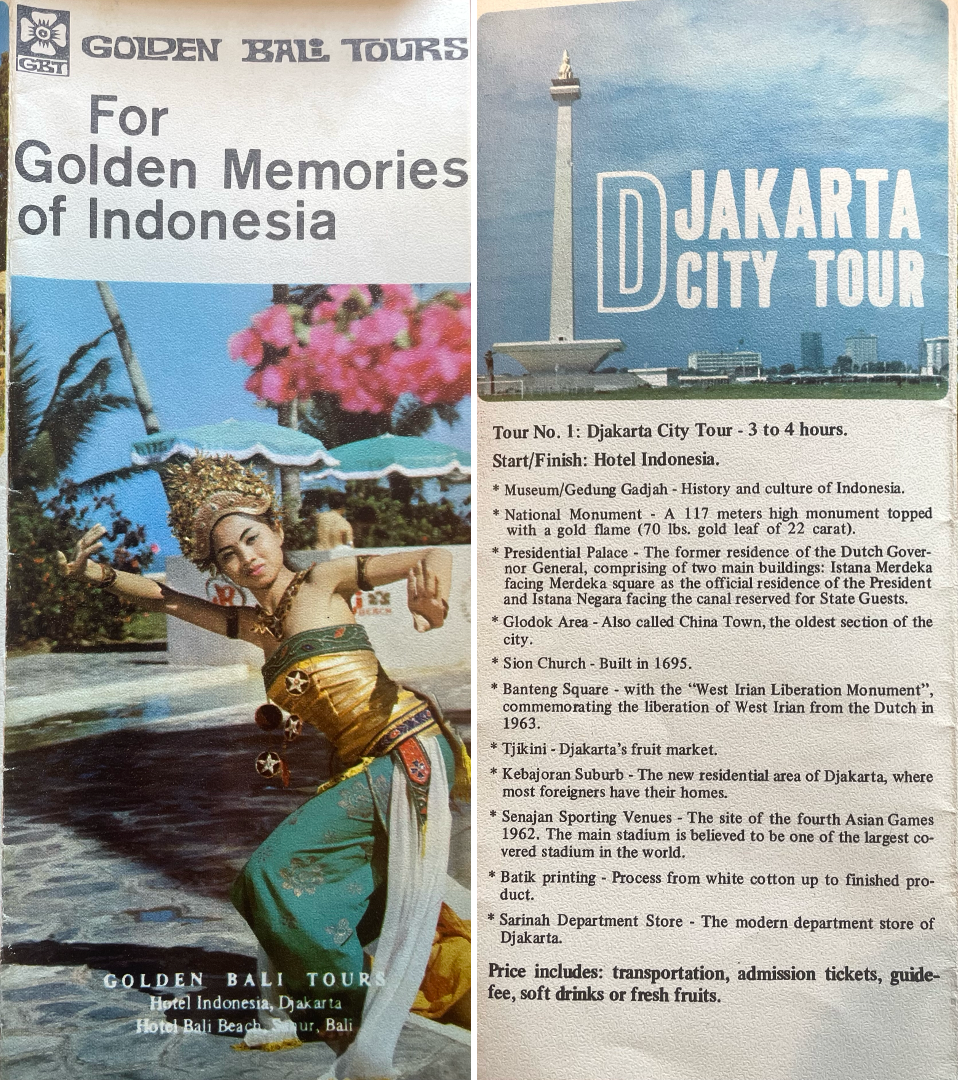
On a page that looks like it was torn from a travel guidebook it says “Indonesia has one modern hotel, the Hotel Indonesia (in Djakarta) which conforms to American standards in its appointments.” The guidebook only listed a few other tourist hotels in Indonesia—and all the places she and Estella stayed were among them. Here’s a brochure from the hotel with a description of the city tour it looks like they went on.
We went first to the Museum. Believe it was started about 1840. The exhibits of the early people of these islands was most impressive. There were many resemblances to our own Indians, those in Southwest U.S.—and especially to those in Alaska. Bronze elephant given by Chulalongkorn.
She took quite a few pictures in Djakarta. Here is the museum—you can see the elephant out front.
Photo / Katharine Boylan
The monuments in the city are most effective. The National Monument, a flame of gold (the height is about the same as Apollo 11—70m) is beautiful in its simplicity. Independence in 1945 from Dutch. Man with hands up—liberation of Irian (island where Rockefeller was lost) Woman giving bowl of rice to soldier Sculpture given by Russia—woman alone—freedom of women
Here are some of her pictures of the monuments.
Photos / Katharine Boylan
And here are a number of other photos from around Djakarta, including one labeled Estella / Pedicab.
Photos / Katharine Boylan
Batik factory—this was most interesting. Made me realize that whatever batik costs it is still inexpensive. The material not to be colored is covered with wax, then dyed, then put into boiling water. The more colors, the more processes. Some are entirely hand painted.
From her letter home: I added to my supply of dress materials. Batik is hand made in Java and of course I could not resist. Wax is put in the material where no dye is wanted, then removed with hot water. Every color means that it has had that many waxings and removings.
Here are some pictures from her tour, and some batik that was part of a fabric stash our family inherited from her.
Photos / Katharine Boylan
We “did” all the floors of the the Dep’t Store—Sarinah. I bought Pop Corn! We walked to the Cathay Chinese Restaurant. The Betjak (tricycles) had a hard time letting us walk. Roast Duck meant just the skin. I still wonder what they do with the meat.
From her letter home: And that reminds me of going into a Chinese restaurant in Djakarta and ordering roast duck. The waiter finally got it across to us that it was only the skin so we changed our order. A little later an Australian family came in and ordered some because they had had it before. They offered us some and it was delicious. It tasted something like cracklings.
Wed. Dec. 31
The last day of the year, and rather a frustrating one. We went to pick up our tickets, and found that they were not confirmed. We went to the Aquarium—found it most disappointing. The aquarium in the hotel was more interesting and certainly more beautiful. We went out to the airport, hoping to get a standby ticket, but in vain.
Thur. Jan. 1, 1970
Estella watched the crowds and the fireworks last night. My intention was to get up and watch, but I did not waken until this a.m. We walked, through the heat, to the museum, but as we feared it was closed. Almost everything is closed for the holiday.
Here are some New Year’s horns and holiday lights.
In airport—Djakarta—Sign made of marigolds—edged with three rows of anthurium, letters in small purple ball flowers: Gov. of Djakarta Wishes a Happy and Prosperous New Year 1970
We were all given orchids to wish us a Happy New Year from the Governor.
Much excitement in the airport—we wondered if Agnew was coming in.
Vice President Agnew was on a multi-country tour of Asia at this time. It looks like he didn’t get to Indonesia until a few days later, but I’m sure there was a kerfuffle as they got ready!
Impressions— The lushness of the foliage in Bali, Central Java, the Gardens, Djakarta. The neatness and precision with which the rice fields in Bali are kept. Spirit houses near the rice fields. The growing of rice is tied up with the religion—animism—in Bali. Buying mangosteens at the volcano—at least three dozen, in a pretty basket—for 100 rupeas, about 25c. Never did mangosteens taste better. Having a ride on Christmas morning in an outrigger canoe. Going beachcombing at 5:30 in the morning. Watching the tide come in under a full moon. Riding a pedicab, driver in the rear. Sitting in the airport in Djakarta as a standby, and not making it. Being constantly besieged by children who want to sell things, and bargaining for the things one wants. A nine hour train ride—crowded beyond belief—but made bearable because of the good nature, the sharing of food, seats, and communicating even if it was only through smiles. Hearing music and following it to discover a street dance—the Horse Dance. The “horses” made of matting. Seeing people in many different and very interesting costumes.
I’ll close with one more set of photos—K was apparently fascinated by Big Hats, as she had quite a few labeled pictures of them, in both town and country.
Photos / Katharine Boylan
And that’s the end of this trip! Next week K will be back in Chiang Mai for the next chapter of the adventure.